
India’s space ambitions faced an unexpected jolt as the Indian Space Research Organisation (ISRO) encountered back-to-back setbacks involving its trusted Polar Satellite Launch Vehicle (PSLV). Long regarded as one of the most reliable launch vehicles in the global space industry, PSLV has been the backbone of India’s satellite deployment missions for decades. However, recent technical issues and mission anomalies have sparked concern within the scientific community and raised questions about the challenges ahead for ISRO.
PSLV: ISRO’s Workhorse Under Scrutiny
Since its first successful flight in the mid-1990s, PSLV has earned a reputation for precision, reliability, and cost-effectiveness. The launch vehicle has placed hundreds of satellites into orbit, not only for India but also for several international customers. Its success rate has been a major factor in establishing India as a credible space-faring nation.
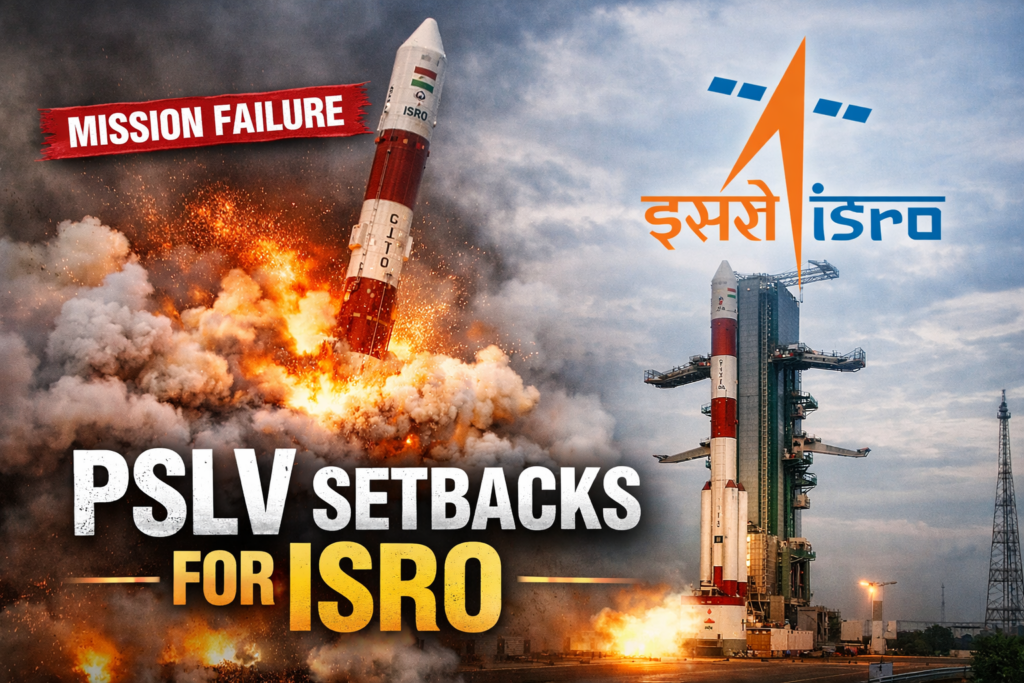
However, the recent back-to-back issues involving PSLV have drawn attention because such occurrences are rare for this launch vehicle. While ISRO has experienced failures in its early years, consistent performance over the last two decades made PSLV nearly synonymous with mission assurance.
The latest setbacks have therefore come as a surprise, especially at a time when India’s space programme is expanding rapidly with ambitious scientific, commercial, and human spaceflight goals.
Understanding the Recent Setbacks
According to official information released by ISRO, the recent PSLV missions encountered technical anomalies that prevented them from achieving their intended objectives. While initial launch phases reportedly proceeded as planned, issues emerged during critical stages of the mission, including payload deployment and orbit insertion.
In one instance, a deviation in onboard systems led to incorrect satellite separation, while another mission experienced performance-related challenges in one of the rocket’s stages. Though the launch vehicle itself completed most of its flight sequence, the anomalies resulted in partial or complete mission failure.
ISRO has clarified that no safety hazards were involved and that ground systems and launch infrastructure remained unaffected. However, the inability to deliver payloads accurately into their designated orbits marked a significant setback.
Impact on India’s Space Programme
The immediate impact of these back-to-back PSLV issues is largely operational. Satellites represent years of development and significant financial investment, and any delay or loss can affect scientific research, communication services, and Earth observation programmes.
Beyond operational concerns, such setbacks can influence mission timelines, especially for upcoming launches. ISRO may choose to pause PSLV flights temporarily while conducting detailed investigations, which could lead to delays in scheduled missions.
Internationally, India’s reputation as a reliable launch service provider may also come under closer scrutiny. PSLV has been a popular choice for small and medium satellite launches due to its affordability and proven track record. Even though two setbacks do not erase decades of success, they may prompt commercial customers to seek additional assurances before future launches.
Technical Challenges and Growing Complexity
Experts believe that increasing mission complexity could be a contributing factor. Modern satellites demand higher precision in orbit placement, advanced onboard systems, and tighter tolerances. As ISRO upgrades PSLV with newer avionics, propulsion enhancements, and digital systems, the margin for error becomes smaller.
Additionally, ISRO is simultaneously working on multiple next-generation launch vehicles, including the Gaganyaan human spaceflight programme, the LVM series, and small satellite launch vehicles. Balancing multiple large-scale projects places immense pressure on engineering teams and resources.
Some analysts also point out that incremental upgrades to a long-serving launch vehicle like PSLV require meticulous testing. Even minor changes can have unintended consequences if not fully validated across all mission profiles.
ISRO’s Response and Investigation Process
ISRO has initiated a comprehensive failure analysis following standard protocol. A high-level failure analysis committee has been constituted to examine telemetry data, flight performance, and ground test results.
Such investigations typically involve months of simulation, hardware inspection, and system-level reviews. ISRO has a strong track record of learning from failures and implementing corrective measures swiftly. Past setbacks have often resulted in design improvements that strengthened future missions.
Officials have emphasized that transparency and technical rigor will guide the investigation process. The findings will play a crucial role in determining when PSLV returns to flight and what changes may be introduced to prevent similar issues.
Lessons from Past Setbacks
Historically, ISRO has emerged stronger after facing challenges. From early launch failures to mission anomalies in lunar and planetary programmes, each setback has contributed to institutional learning and technological maturity.
The space agency’s resilience lies in its methodical approach to problem-solving. Engineers often revisit fundamental assumptions, re-test systems under extreme conditions, and implement redundancies where necessary.
In this context, the current PSLV setbacks are seen by many experts as part of the natural evolution of a growing space programme rather than a sign of systemic weakness.
What Lies Ahead for PSLV
Despite recent issues, PSLV is expected to remain a key component of ISRO’s launch portfolio. Its versatility, proven design, and adaptability make it difficult to replace in the short term.
However, ISRO may increase reliance on other launch vehicles such as LVM3 and upcoming small satellite launch systems while corrective measures are implemented. Additional ground testing and simulation runs are also likely before PSLV resumes regular flights.
The space agency’s long-term vision includes transitioning toward more advanced and reusable launch systems, which could gradually reduce dependence on older platforms. Still, PSLV’s legacy and continued relevance ensure it will remain under focus for years to come.
Conclusion
The back-to-back PSLV rocket setbacks mark a challenging phase for ISRO but do not overshadow its decades of achievement. In the highly complex and unforgiving domain of space exploration, failures are an inherent risk, even for the most experienced agencies.
ISRO’s response to these setbacks—through rigorous investigation, transparency, and corrective action—will determine how quickly confidence is restored. For now, the incidents serve as a reminder that space missions demand constant vigilance, continuous improvement, and an unwavering commitment to precision.
As ISRO prepares for its next chapter, including human spaceflight and deep-space exploration, the lessons learned from these PSLV setbacks may ultimately strengthen India’s journey beyond Earth.