
The first One Day International between India and New Zealand lived up to expectations as fans witnessed an exciting contest filled with momentum shifts, quality performances, and moments of individual brilliance. Played in front of a packed crowd, the match marked the beginning of a highly anticipated three-match ODI series, with both teams looking to assert early dominance.
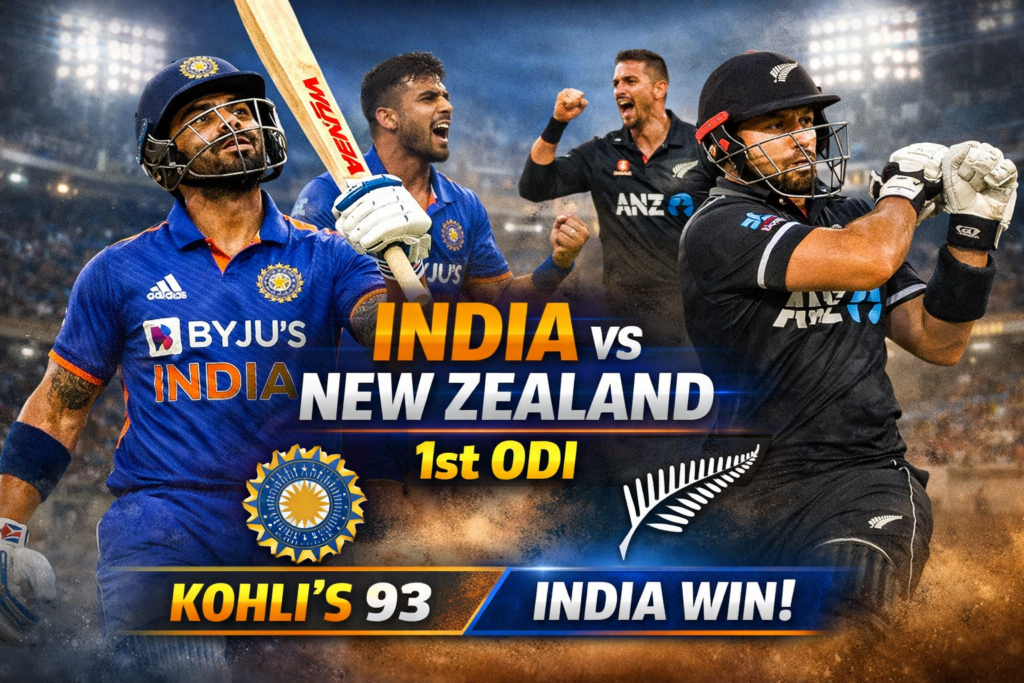
India eventually emerged victorious, showcasing depth in both batting and bowling. While the win will be remembered as a complete team effort, one of the most talked-about moments of the match was Virat Kohli’s dismissal at 93, just seven runs short of his much-awaited 85th ODI century. Despite missing out on the milestone, Kohli’s innings played a crucial role in setting the tone for India’s commanding performance.
Toss and Team Combinations
New Zealand won the toss and elected to bowl first, a decision influenced by early pitch conditions and the belief that chasing under lights would be easier. India, however, looked well-prepared to bat first and fielded a balanced XI featuring a mix of experienced players and emerging talents.
India’s playing XI reflected a strong batting lineup backed by versatile all-rounders and a varied bowling attack. New Zealand, on the other hand, relied on their disciplined pace unit and dependable middle order to challenge the hosts.
India’s Innings: A Blend of Stability and Aggression
India got off to a steady start, with the openers focusing on preserving wickets during the initial overs. The New Zealand pacers maintained tight lines early on, extracting some movement and making run-scoring difficult. Despite the pressure, India avoided early damage, laying a solid foundation.
The real momentum shift came once Virat Kohli walked in. From the moment he settled at the crease, Kohli looked composed, confident, and in complete control. Rotating the strike efficiently and punishing loose deliveries, he built partnerships that allowed India to steadily increase the run rate.
Kohli’s innings was a masterclass in ODI batting. He mixed caution with aggression, finding gaps with precision and timing the ball beautifully through the covers and mid-wicket. His running between the wickets was sharp, keeping the New Zealand fielders under constant pressure.
Virat Kohli’s 93: So Close, Yet So Far
The highlight of India’s innings was undoubtedly Virat Kohli’s knock of 93 runs. Fans inside the stadium and millions watching on television were eagerly waiting for him to reach his century. With every boundary, the anticipation grew louder.
Unfortunately for Kohli and his supporters, the milestone remained elusive. Attempting to accelerate the scoring, Kohli mistimed a shot and was caught in the deep. The dismissal stunned the crowd into silence, followed by loud applause acknowledging a brilliant innings.
Though he missed out on a century, Kohli’s contribution was invaluable. His knock anchored the innings and ensured India remained on track for a competitive total. Once again, he proved why he is regarded as one of the greatest ODI batters of all time.
Middle Order and Finishing Touches
After Kohli’s dismissal, India’s middle order took responsibility to maintain momentum. The batters played with intent, targeting the final overs and capitalizing on any loose deliveries. Quick singles, well-placed boundaries, and smart shot selection helped India push the score beyond the 300-run mark.
New Zealand’s bowlers tried to pull things back in the death overs, but India’s batting depth proved too strong. The final total reflected a well-paced innings built on partnerships rather than reckless hitting.
India eventually posted a competitive total, putting significant pressure on New Zealand’s batting lineup.
New Zealand’s Chase: A Promising Start That Faded Away
Chasing a big target, New Zealand needed a strong start, and their openers initially showed positive intent. They attacked the Indian pacers early, picking up boundaries and keeping the required run rate in check.
However, India struck at crucial moments. The first breakthrough shifted momentum, and from there, the Indian bowlers tightened their grip on the game. Regular wickets prevented New Zealand from building long partnerships, which ultimately proved costly.
Indian Bowling: Discipline and Variety
India’s bowling unit delivered a disciplined performance, combining pace, swing, and spin effectively. The fast bowlers used the new ball well, hitting the right lengths and forcing mistakes from the batters.
As the innings progressed, the spinners came into play, slowing the scoring rate and picking up key wickets. Their control in the middle overs ensured New Zealand never fully recovered from losing early wickets.
Fielding also played a vital role in India’s success. Sharp catches and quick ground fielding added pressure, resulting in run-outs and false shots.
Key Turning Points of the Match
Several moments stood out as decisive in the context of the match:
- Virat Kohli’s partnership during the middle overs, which stabilized India’s innings
- Kohli’s dismissal at 93, which momentarily slowed India but did not derail the innings
- Early wickets during New Zealand’s chase, preventing a strong platform
- Tight bowling spells in the middle overs that increased the required run rate
Each of these moments contributed to India’s eventual dominance.
Player of the Match Performance
While several players delivered impactful performances, the award could easily be justified for a batter who anchored the innings or a bowler who dismantled the opposition. India’s victory was truly a team effort, highlighting the depth and balance of the squad.
What This Win Means for India
Winning the first ODI gives India an important psychological advantage in the series. It reflects their strong preparation, adaptability, and ability to handle pressure situations. The performance also highlights the healthy competition within the squad, with players stepping up when needed.
For Virat Kohli, despite missing out on a century, the innings will boost his confidence. His form remains a positive sign for India as they prepare for upcoming international challenges.
Concerns for New Zealand
New Zealand will need to regroup quickly. While there were positives, such as their initial intent with the bat and disciplined spells from certain bowlers, the lack of partnerships and inability to contain India’s middle order hurt their chances.
The team will likely focus on improving execution in key moments and finding ways to break partnerships earlier in the next match.
Looking Ahead: 2nd ODI Expectations
With the series still open, the second ODI promises another thrilling contest. New Zealand will aim to bounce back strongly, while India will look to build on their momentum and secure the series early.
Fans can expect tactical adjustments, possible changes in team combinations, and another high-quality game between two competitive sides.
Conclusion
The India vs New Zealand 1st ODI was a complete spectacle of modern-day cricket. India’s all-round performance, highlighted by Virat Kohli’s classy 93, set the tone for the series. Though the century eluded him, Kohli once again proved his importance to the team.
As the series progresses, both teams will look to fine-tune their strategies, making this contest even more exciting for cricket fans around the world.