
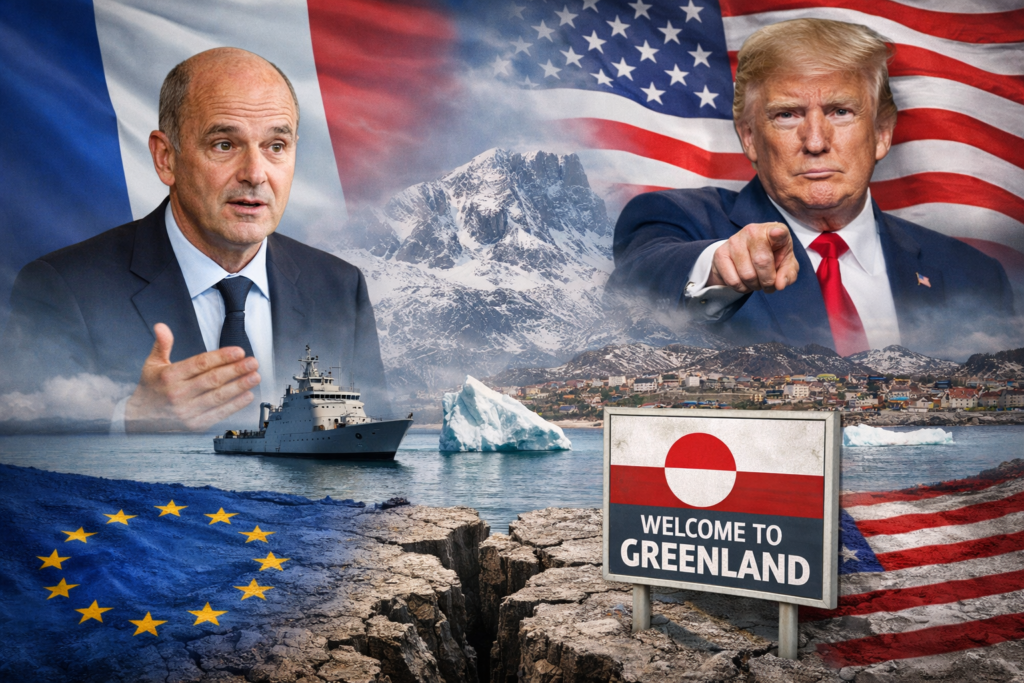
France has issued a strong warning to the United States over any attempt to seize Greenland, saying such a move would cross a red line and seriously damage Europe’s economic relationship with Washington. The warning highlights growing tensions between European leaders and the US administration over territorial claims, trade policy, and geopolitical strategy in the Arctic region.
French Finance Minister Roland Lescure raised the issue directly with US Treasury Secretary Scott Bessent during meetings in Washington this week. According to Lescure, Europe is deeply concerned by repeated statements from former US President Donald Trump suggesting that the United States could take control of Greenland, a territory that belongs to the Kingdom of Denmark.
“A Sovereign Territory Cannot Be Touched”
Lescure made it clear that France considers Greenland to be a non-negotiable matter of sovereignty. He stressed that Greenland is part of Denmark, which is a member of the European Union, and therefore any hostile move would have serious political and economic consequences.
“Greenland is a sovereign part of a sovereign country that belongs to the European Union,” Lescure said, adding that such matters should not be treated lightly or used for political pressure.
While stopping short of discussing direct retaliation, the French minister hinted that the EU would be forced to reassess its entire relationship with the US if such an unprecedented action were to occur.
EU–US Trade Relationship at Stake
The warning carries significant weight because the EU and the US share the largest bilateral trade relationship in the world. Trade in goods and services between the two sides crossed €1.6 trillion in 2024, making the United States Europe’s biggest export destination.
Any major political conflict—especially one involving territorial integrity—could disrupt trade flows, investment, and long-standing economic cooperation. European leaders fear that uncertainty created by US claims on Greenland could destabilize not just regional security but also global markets.
Trump’s Greenland Remarks Raise Alarm
Trump has repeatedly stated in recent weeks that the US would take “ownership” of Greenland, arguing that the Arctic territory is critical to American national security. These comments have caused unease across Europe, particularly in Nordic countries and EU capitals.
Greenland’s strategic importance has grown in recent years due to melting ice, new shipping routes, and access to rare earth minerals, which are vital for modern technologies and defense systems.
Cooperation Despite Disagreements
Despite the tension, Lescure emphasized that Europe still wants to maintain dialogue with Washington. He described the current US stance as paradoxical—sometimes acting as a close ally and at other times as an unpredictable adversary.
France, he said, continues to cooperate with the US on global priorities, including a French-led initiative within the G7 to reduce dependence on China for rare earth materials. Discussions are underway to diversify supply chains, set price safeguards, and develop joint purchasing agreements.
France plans to present concrete proposals at the G7 summit scheduled to be held in Evian in June.
“We need to move faster,” Lescure said, warning that both China and the US are advancing rapidly in strategic sectors while Europe risks falling behind.
Tech Regulation Also a Flashpoint
Greenland is not the only issue straining EU–US relations. Another major area of friction is Europe’s regulation of American technology companies.
During talks, Bessent reportedly expressed frustration over heavy fines imposed on US tech firms operating in Europe. One recent example includes a significant penalty levied against Elon Musk’s social media platform X.
Lescure responded firmly, stating that European laws apply to all companies doing business in the EU, regardless of their country of origin. “If you operate in Europe, you follow European rules,” he said.
France’s Domestic Challenges Weaken Its Position
While France is pushing for a stronger and more assertive European role on the global stage, its domestic political situation remains fragile. The country is struggling with high budget deficits and a deeply divided parliament, making economic reform difficult.
France aims to reduce its budget deficit to 5% of GDP in 2026, down from 5.4% in 2025. However, the government lacks a parliamentary majority and has been forced to negotiate with opposition parties, particularly the center-left Socialists.
Prime Ministerial instability has further complicated matters, with four prime ministers serving in just 18 months.
Risk of Political Instability
If budget negotiations fail, the government may use constitutional powers to bypass parliament—a move that could trigger a no-confidence vote and potentially bring down the administration.
This paralysis has benefited the far-right Rassemblement National (RN), led by Marine Le Pen and Jordan Bardella, who are currently leading opinion polls ahead of the 2027 presidential election.
Lescure accused the RN of economic incompetence, arguing that their voting record in parliament contradicts their attempts to portray themselves as business-friendly.
Business Confidence and Political Stability
In a controversial move, the government has agreed to scrap or delay some of President Emmanuel Macron’s key economic reforms, including changes to the retirement age. It also plans to extend a temporary tax on large corporations, angering many business leaders.
Defending the decision, Lescure said political stability comes at a cost. “Stability has a price,” he said, acknowledging that businesses may have to shoulder part of the burden to prevent deeper political unrest.
A Delicate Balance Ahead
As geopolitical tensions rise and domestic pressures mount, France finds itself walking a tightrope—seeking to stand firm against US pressure while maintaining critical economic and strategic partnerships.
The Greenland issue has become a symbol of broader uncertainty in transatlantic relations, testing the strength of alliances that have lasted for decades. How Europe and the US manage these disagreements may shape the future of global trade, security, and diplomacy.