
Mumbai, January 17, 2026
A day after the Congress registered its worst-ever performance in the Brihanmumbai Municipal Corporation (BMC) elections, internal fault lines within the party widened, with senior leader Bhai Jagtap demanding the resignation of Mumbai Congress unit chief Varsha Gaikwad on moral grounds. The demand has brought the spotlight back on long-simmering factionalism in the party’s city unit at a time when Congress is struggling to remain politically relevant in India’s financial capital.
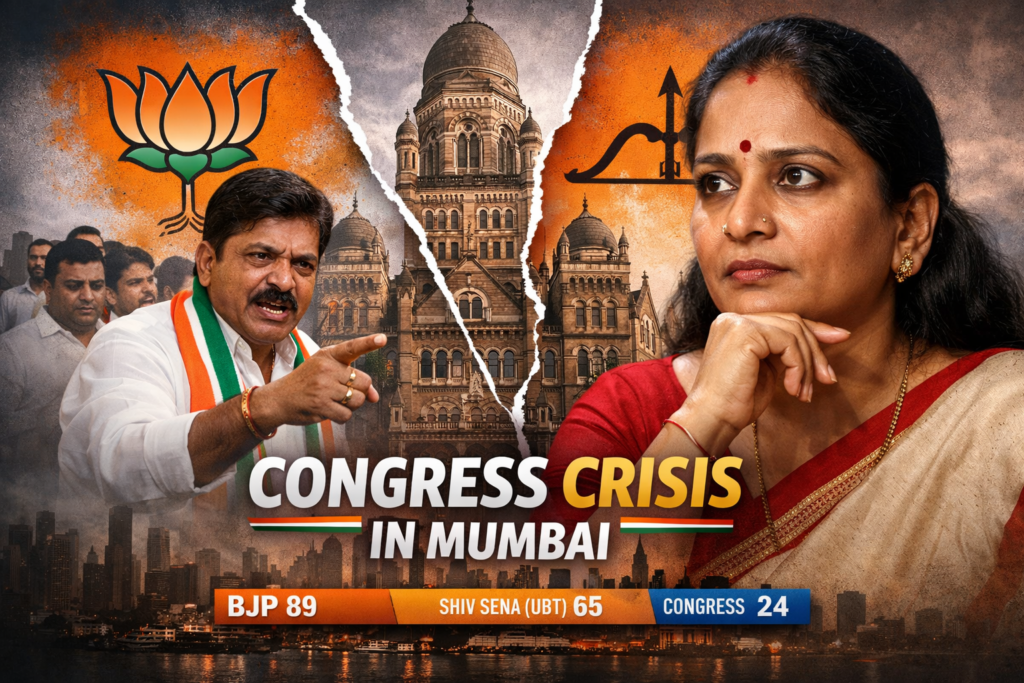
Congress Records Historic Low in Mumbai Civic Polls
The Congress’s tally in the 227-member BMC fell to 24 seats, down from the 31 it had secured in the 2017 elections. While the decline may appear modest numerically, party leaders and observers agree that the result represents a historic low for a party that once played a decisive role in Mumbai’s civic and political landscape.
The setback has been particularly jarring given the high stakes attached to the BMC, which is considered Asia’s richest municipal body. Control of the civic corporation not only confers administrative influence but also carries immense symbolic value in Maharashtra politics.
Bhai Jagtap Leads Attack on Gaikwad
Former Mumbai Congress president and Member of the Legislative Council Bhai Jagtap was among the first to openly question the leadership of Varsha Gaikwad following the results. Speaking to PTI Videos, Jagtap said that Gaikwad should step down to take moral responsibility for the party’s poor showing.
“When candidates were selected, I was told that tickets were distributed based on a survey. I didn’t object at that time. But when I later asked to see the survey, it was not shown to me,” Jagtap said, alleging a lack of transparency in ticket distribution. He stressed that the Congress’s performance marked a historic low and warranted accountability at the top.
His remarks have resonated with a section of party workers who believe that flawed candidate selection, weak booth-level mobilisation, and a disconnect with local issues contributed to the Congress’s underwhelming performance.
Alliance Strategy Under Scrutiny
Another major factor under criticism is the Congress’s decision to stay out of an alliance with its traditional Maha Vikas Aghadi (MVA) partners in the BMC polls. Instead of joining hands with Shiv Sena (UBT) and the Nationalist Congress Party factions, the Congress chose to contest in alliance with the Vanchit Bahujan Aghadi (VBA), Rashtriya Samaj Party (RSP), and the Republican Party of India (Gavai).
The alliance contested 152 seats, but the outcome was disastrous for Congress’s partners, all of whom failed to win a single seat. Political analysts argue that the decision fragmented the Opposition vote, indirectly aiding the Bharatiya Janata Party (BJP) in consolidating its position.
Many within the Congress now believe that contesting separately from the MVA cost the party dearly, both in terms of seats and political credibility. The alliance strategy, critics say, confused voters and diluted the party’s core support base in key wards.
BJP’s Big Win and Changing Political Landscape
The BMC election results marked a watershed moment in Mumbai politics. The BJP emerged as the single largest party with 89 seats, wresting control of the civic body from the Shiv Sena and ending the Thackeray family’s three-decade-long dominance over the BMC.
Shiv Sena, aligned with the ruling Mahayuti, won 29 seats, while in the Opposition camp, Shiv Sena (UBT) secured 65 seats. The Maharashtra Navnirman Sena (MNS) won six seats, the All India Majlis-e-Ittehadul Muslimeen (AIMIM) bagged eight, the Nationalist Congress Party won three, the Samajwadi Party two, and the NCP (Sharad Pawar faction) managed just one seat.
The results underline a significant shift in Mumbai’s political equations, with the BJP consolidating its urban base and Opposition parties struggling to present a unified challenge.
Varsha Gaikwad Under Pressure
Varsha Gaikwad, who has been at the helm of the Mumbai Congress unit, now finds herself under intense pressure. While she has not publicly responded to Jagtap’s demand, sources within the party say the leadership is closely monitoring the situation.
Gaikwad’s supporters argue that the Congress’s decline in Mumbai is part of a longer trend and cannot be attributed solely to the current city leadership. They point to organizational weaknesses, limited resources, and the party’s shrinking footprint in urban Maharashtra as structural challenges that go beyond one election.
However, critics counter that leadership accountability is essential to rebuild the party’s morale and credibility among voters. They argue that without introspection and corrective measures, the Congress risks further marginalisation in Mumbai.
Factionalism Resurfaces
The controversy has once again exposed deep-rooted factionalism within the Mumbai Congress. Differences between senior leaders over strategy, candidate selection, and alliances have frequently surfaced in the past, often undermining the party’s electoral prospects.
Political observers note that such public displays of dissent, especially in the aftermath of a defeat, could further weaken the party’s organisational cohesion. At the same time, they say the debate reflects genuine frustration among leaders and workers who feel sidelined in decision-making processes.
What Lies Ahead for Congress in Mumbai?
As the dust settles on the BMC election results, the Congress faces tough questions about its future in Mumbai. Whether the party leadership will accept demands for resignations or attempt to paper over cracks remains to be seen.
For now, the focus is likely to be on damage control, internal reviews, and recalibrating strategies ahead of upcoming local body and Assembly elections. The episode underscores the urgent need for the Congress to address leadership issues, rebuild grassroots networks, and clarify its alliance politics if it hopes to regain lost ground in Maharashtra’s capital.
The call for Varsha Gaikwad’s resignation may be just the beginning of a larger churning within the party, as it grapples with the reality of its diminishing influence in one of India’s most politically significant cities.