
Prime Minister Narendra Modi on Sunday inaugurated, laid the foundation stone for, and flagged off development projects worth over ₹830 crore in West Bengal’s Hooghly district, marking a major infrastructure push in the state amid an intensifying political battle ahead of the 2026 Assembly elections.
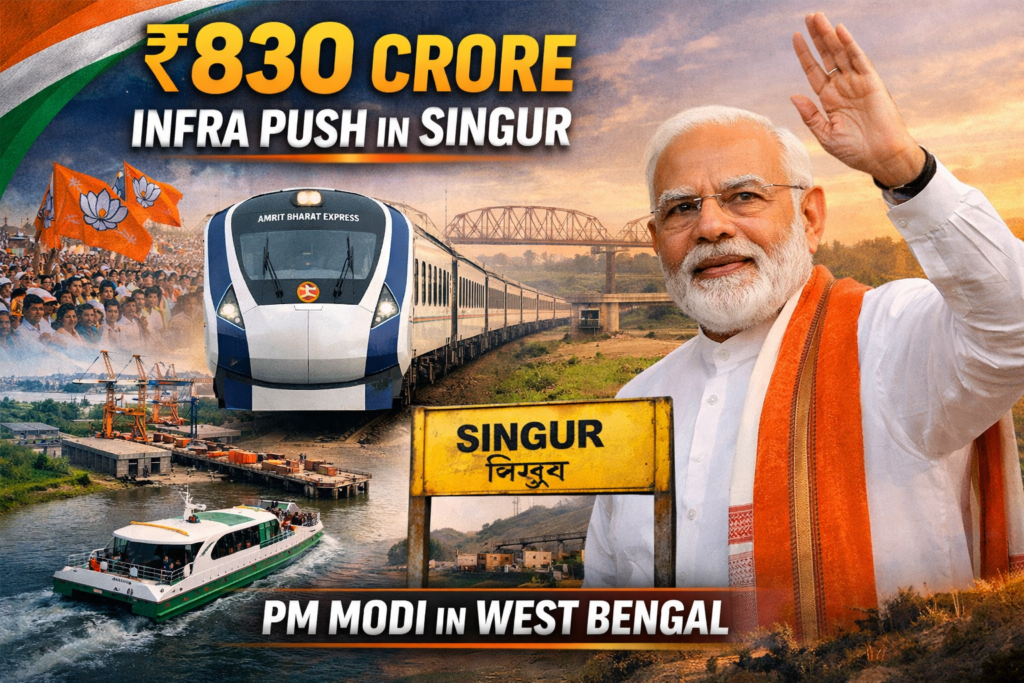
Addressing a public rally at Singur, the Prime Minister underscored the Centre’s focus on industrialisation, connectivity and sustainable mobility, while the Bharatiya Janata Party (BJP) sharpened its political messaging around investment and economic growth in the state. Singur, the site of the abandoned Tata Nano car project, carries deep political symbolism and has long been cited by the BJP as an example of West Bengal’s “lost industrial opportunity”.
The Prime Minister arrived in West Bengal after an overnight halt in Assam as part of a two-day visit to the eastern region.
Balagarh Port Gate System Launched
According to the Prime Minister’s Office (PMO), a key highlight of the visit was the laying of the foundation stone for the Extended Port Gate System at Balagarh. The project includes an Inland Water Transport (IWT) terminal and a Road Over Bridge and is spread across nearly 900 acres.
Designed as a modern cargo-handling facility, the Balagarh terminal is expected to have a capacity of 2.7 million tonnes per annum. It will feature two jetties—one for containerised cargo and another for dry bulk cargo. Officials said the project aims to divert heavy freight traffic away from congested urban corridors, particularly in Kolkata, thereby easing traffic congestion, improving road safety and reducing pollution.
The Centre believes the project will strengthen multimodal logistics in the region and improve the efficiency of cargo evacuation from ports.
Electric Catamaran for Hooghly River
In a push towards green and sustainable transport, PM Modi also launched a state-of-the-art electric catamaran in Kolkata to boost urban river mobility, eco-tourism and last-mile connectivity along the Hooghly River.
Built indigenously by Cochin Shipyard Ltd, the 50-passenger hybrid electric aluminium catamaran is equipped with advanced electric propulsion systems and lithium-titanate battery technology. The vessel is capable of zero-emission operations in electric mode, while the hybrid mode allows for extended endurance. It is one of six such vessels being constructed for inland water transport services.
Rail Connectivity Gets a Boost
Rail infrastructure featured prominently in the day’s agenda. The Prime Minister inaugurated the Jayrambati–Barogopinathpur–Maynapur new rail line, a crucial section of the under-construction Tarkeshwar–Bishnupur rail project. A new passenger train service between Maynapur and Jayrambati, with a halt at Barogopinathpur, was also flagged off.
The new rail link is expected to provide direct connectivity to Bankura district, benefiting daily commuters, students and pilgrims travelling to religious destinations in the region.
Additionally, PM Modi flagged off three Amrit Bharat Express trains—Howrah–Anand Vihar Terminal, Sealdah–Banaras, and Santragachi–Tambaram—aimed at strengthening long-distance rail connectivity between West Bengal and key regions across the country.
Singur and the Political Context
The choice of Singur as the rally venue was widely seen as politically significant. Nearly two decades ago, protests against land acquisition for the Tata Motors Nano project forced the company to relocate the plant to Gujarat. The BJP has consistently invoked the episode to criticise the Trinamool Congress (TMC) government and has promised to revive industrial growth in the state if voted to power.
On Saturday, the Prime Minister had launched multiple rail and road projects from Malda and flagged off the first Vande Bharat sleeper train service between Howrah and Guwahati. During his speeches, he also targeted the Mamata Banerjee-led TMC government, alleging the existence of a “syndicate raj” and accusing the state administration of enabling illegal infiltration.
Escalating BJP–TMC Tensions
The infrastructure announcements come amid escalating political tensions between the BJP and the TMC. Earlier this week, the West Bengal Police filed four FIRs against 20 Enforcement Directorate (ED) officials following a raid at the I-PAC office, accusing them of trespass and obstruction. The move marked a rare instance of state police action against a central investigative agency.
The matter soon reached the Supreme Court, which ordered a halt to police investigations against the ED officials, effectively pausing the probe and adding a judicial dimension to the political confrontation.
With Assembly elections expected in early 2026, Sunday’s infrastructure push and the choice of Singur as a political मंच underline the BJP’s attempt to project development, connectivity and industrial revival as central themes in its West Bengal campaign.