
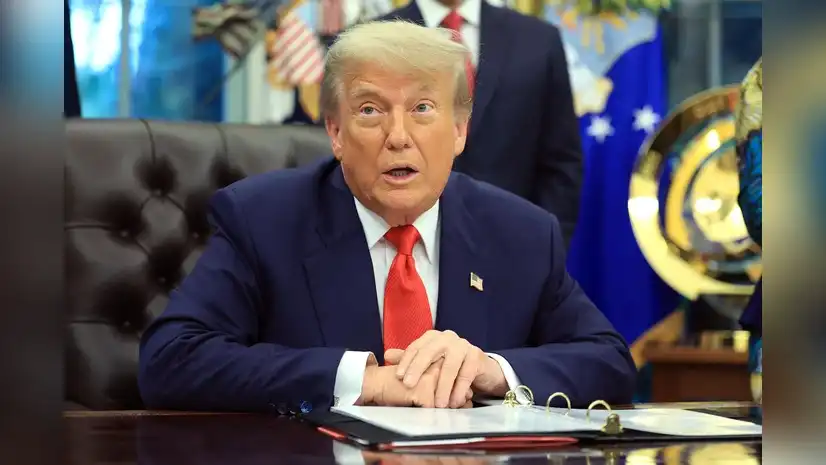
New Delhi, July 2, 2025 — In a major development that could reshape global trade dynamics, Trump says trade deal with India is on the horizon, just days ahead of the crucial July 9 tariff deadline. US President Donald Trump has stated that a bilateral agreement between the United States and India will be finalized “soon,” potentially avoiding the reimposition of a 26 percent tariff that has been temporarily suspended since April.
The announcement, made during a press briefing on Tuesday, has sparked hope in both political and economic circles that years of trade disagreements between the two nations may be nearing resolution. Trump says trade deal with India will bring down tariffs, create fairer competition, and offer enhanced market access for US businesses operating in the South Asian economy.
“I think we are going to have a deal with India, and it’s going to be a different kind of deal,” Trump said. “It will allow us to compete. Right now, India doesn’t accept anybody in. But if that changes, we’ll have a deal with much less tariffs.”
Table of Contents
Trump Says Trade Deal with India Will Open Market Access
In his remarks, President Trump says trade deal with India is critical because it would allow US companies to gain a level playing field in the Indian market. Historically, India has been known for its high tariffs and restrictive import policies, which many American businesses argue have limited their ability to compete. With growing US-India economic ties, both countries are under pressure to strike a mutually beneficial agreement.
The timing is critical: On April 2, the Trump administration imposed a 26 percent tariff on select Indian exports. This decision was later paused for 90 days to allow space for negotiations. However, that pause will expire on July 9. Without an agreement in place, those tariffs are set to snap back into effect, potentially straining the already delicate relationship between the two democracies.
Trump says trade deal with India is now very close, suggesting that India may be willing to reduce trade barriers and open its markets to American goods and services.
US Treasury Confirms Progress: Trump Says Trade Deal with India Almost Done
Backing up Trump’s statement, US Treasury Secretary Scott Bessent told Fox News that the United States and India are nearing a final settlement. “We are very close with India,” Bessent confirmed. His comments came amid growing speculation that both countries are racing against the clock to avoid an escalation in trade tensions.
In line with this, Trump says trade deal with India will likely be concluded before the tariff deadline, which would be a huge win for the administration heading into the second half of 2025. Both leaders—Trump and Indian Prime Minister Narendra Modi—have been under domestic pressure to deliver results and strengthen bilateral ties.
Reports indicate that the two countries are currently finalizing details of a Bilateral Trade Agreement (BTA) that covers a wide array of goods, services, and investment areas.
Indian Negotiators Extend Stay in Washington
As Trump says trade deal with India is in the final stage, the Indian delegation, led by Chief Negotiator Rajesh Agrawal, has extended its stay in Washington. Originally scheduled for two days of talks, the discussions have now stretched into the weekend.
According to a report from ANI, this extension underscores the seriousness and urgency both sides are attaching to the matter. Talks are said to be intense and detailed, covering everything from agricultural access to manufacturing imports and service sector liberalization.
If Trump says trade deal with India is signed before July 9, it would prevent the resumption of the suspended tariffs and could set the stage for a long-term economic partnership between the two global powers.
Agriculture: The Thorny Issue in Talks
Despite the optimism in Washington and New Delhi, agriculture remains one of the most contentious points in the ongoing discussions. Trump says trade deal with India is close, but the agricultural sector has proven difficult to navigate. India, with its vast population of small-scale and subsistence farmers, is wary of making any concession that could hurt local livelihoods.
The United States, on the other hand, is pushing hard for reduced import duties on American agricultural products, including apples, almonds, walnuts, and genetically modified crops. The Trump administration views access to India’s growing consumer market as a key opportunity for American farmers.
India, however, has been reluctant to lower tariffs or allow genetically modified produce into its domestic markets. It has also stood firm on its protection of the dairy industry—a politically sensitive sector for Indian policymakers. Previous trade deals have seen India refusing to open its dairy sector to foreign competition, and it appears unwilling to make an exception now.
Trump Says Trade Deal with India to Benefit Both Economies
Even amid these differences, Trump says trade deal with India will bring mutual economic gains. The United States wants to sell more products to India, while India is seeking broader access for its labor-intensive exports like textiles, garments, gems and jewellery, leather goods, and marine products.
According to trade experts, India is eyeing reduced restrictions for its exports of shrimp, bananas, oilseeds, and grapes, which are vital to the livelihood of millions of Indian farmers and traders. A compromise allowing mutual concessions could be the breakthrough both nations are hoping for.
Trump’s comments underscore a recognition that India is no longer just a regional power—it is a global economic player whose partnership is essential for American trade policy in Asia.
Trump Says Trade Deal with India Is More Than Just Tariffs
While tariffs remain the focal point of public discourse, the proposed deal goes beyond mere duty reductions. Trump says trade deal with India could also include technology transfers, intellectual property protections, and improved investment opportunities for companies in both nations.
Sources close to the negotiations suggest that Washington is encouraging India to adopt stronger intellectual property laws, particularly in the pharmaceutical and digital sectors. In return, India may benefit from easier visa regimes and favorable investment terms for its startups and service providers in the US.
This multifaceted approach reflects the broader ambition of the agreement. Trump says trade deal with India is not just about goods—it’s about realigning the entire economic relationship between two of the world’s largest democracies.
High Stakes for India’s Economic Growth
For India, reaching a deal is not just politically advantageous—it’s economically urgent. As a fast-growing economy still recovering from pandemic-era disruptions and global supply chain shocks, India needs favorable trade terms with key partners like the US.
If the Trump says trade deal with India turns into action before the July 9 deadline, Indian exporters will retain crucial access to American markets, avoiding billions in potential tariff costs. Sectors like textiles, jewelry, leather, and agriculture are heavily dependent on the American market, and the re-imposition of tariffs could severely damage their profitability.
By agreeing to reciprocal terms that balance protection with market access, India hopes to foster growth without undermining its domestic industries.
Geopolitical Implications: Strengthening the Indo-US Alliance
Apart from trade, Trump says trade deal with India could have major geopolitical implications. Both countries have increasingly aligned their positions on global security, particularly concerning China’s growing influence in the Indo-Pacific.
A successful trade deal would be another step in solidifying the strategic partnership between Washington and New Delhi. Economic cooperation could spill over into stronger defense ties, tech collaboration, and joint efforts in climate and energy initiatives.
Furthermore, with tensions high in various parts of the world, a robust India-US alliance grounded in trade could provide a stabilizing force in Asia and beyond.
Political Optics: Trump and Modi Need a Win
There’s also a significant political dimension to why Trump says trade deal with India must happen now. For Trump, heading into a politically charged season in the US, a foreign policy and economic victory could provide a much-needed boost. He has been campaigning on promises of reshaping trade deals and putting America first—this agreement would be tangible proof of that.
For Indian Prime Minister Narendra Modi, a successful deal with the US reinforces his image as a global statesman and economic reformer. With domestic criticism over inflation and unemployment, Modi’s administration is looking to international successes to bolster its credentials.
What Happens If There’s No Deal?
If Trump says trade deal with India doesn’t materialize by July 9, the 26 percent tariff originally announced on April 2 would automatically come back into effect. This would trigger a tit-for-tat response from India, potentially leading to higher duties on American goods such as Harley-Davidson motorcycles, apples, almonds, and more.
Such an outcome would escalate tensions and could reverse years of diplomatic progress. It would also disrupt supply chains, affect thousands of exporters, and create uncertainty in markets already jittery over inflation and interest rates.
Final Countdown: All Eyes on July 9
As the deadline nears, all eyes are on Washington and New Delhi. Negotiators are racing against time, and both administrations are keen to avoid the political and economic fallout of a failed deal.
What’s clear is that the world is watching. Trump says trade deal with India is coming “very soon,” but whether that promise will translate into a signed agreement before the clock runs out remains to be seen.
Conclusion: Will Trump Deliver?
With just a few days left before the July 9 cutoff, the pressure is on. Trump says trade deal with India will level the playing field and open up markets, while India seeks protection for its most vulnerable sectors and greater access to the American economy.
Both nations have more to gain than lose. If successful, this deal could mark a new chapter in Indo-US relations, driven not just by economics but by shared democratic values and strategic vision.
As the countdown continues, the world waits to see if the promises made by President Trump says trade deal with India will become a reality—or another missed opportunity in global trade diplomacy.